Tool and Situation Matching Worksheets for Aphasia — Choose from the Word Bank
On “Rehabilitation Worksheets,” you will find printable materials for aphasia rehabilitation. For every worksheet listed here, only the first sheet is free to download; a premium membership unlocks the rest.
This page gathers our worksheets that link everyday situations with the tools used in them — “when eating rice” goes with “chopsticks,” “when going out on a rainy day” goes with “umbrella.” They are listed from easiest to hardest.
Why linking tools and situations matters
We do not store words one by one like a dictionary. A word such as “toothbrush” is connected in the mind to brushing, teeth and the bathroom sink. In aphasia, following these connections to reach the right word can become difficult, so a person may not find the name of an object or may mix it up with a similar one. In these worksheets the answers are already in the Word Bank, so there is little pressure to recall words from scratch, and the reader can focus on the links between meanings. Copying the answer also gives writing practice.
Two directions, from easiest to hardest
- Choose the tool for each situation, 6 choices — read a situation and write the name of the tool. The answers are short, so this is a good first step.
- Choose the tool for each situation, 9 choices — more choices, including tools that do similar jobs.
- Choose when each tool is used, 6 choices — the direction is reversed: look at a tool and write the situation it is used in.
- Choose when each tool is used, 9 choices — the hardest step, comparing nine longer phrases.
How to use them effectively
- Before starting, read the Word Bank aloud and talk about when each tool is used.
- Answer the questions you are sure of first, and cross out each word you use; the remaining choices become fewer.
- After writing, say the answer as a full sentence, such as “I use chopsticks when I eat rice,” to practice speaking as well.
- If real objects or photos are at hand, look at them while working through the sheet.
Daily habits differ, and some situations can involve more than one tool. On these worksheets, choosing the best match from the Word Bank counts as correct.
Who these worksheets are for
- Speech-language therapy (ST) sessions for aphasia
- Home practice and self-training
- Language activities at day-care and care facilities
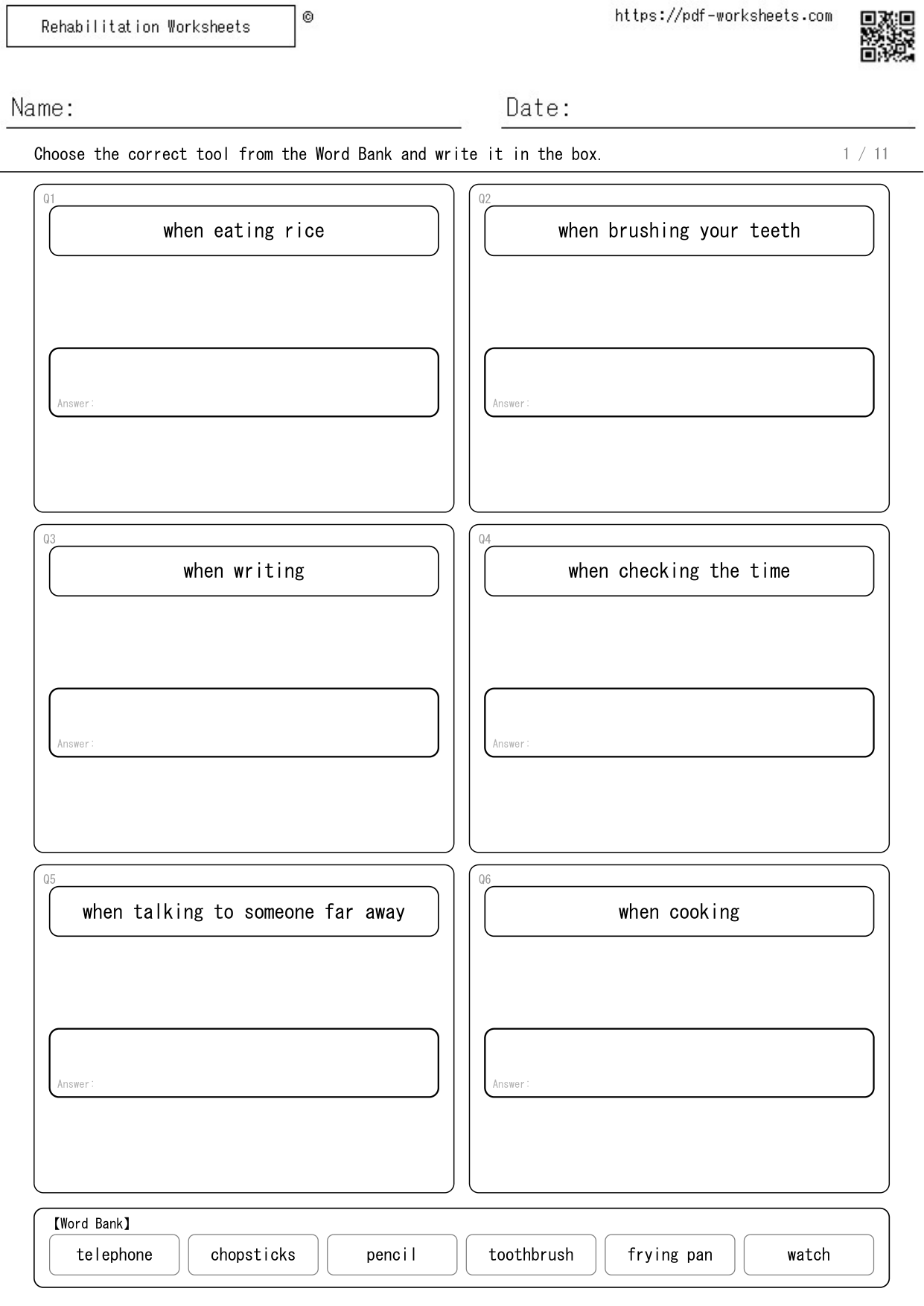
Choose the tool for each situation (6 choices)
Read a situation such as “when brushing your teeth” and choose the tool used for it from the Word Bank. There are six questions and six choices on each sheet. The answers are short object names, which makes this a good first step.
Task to choose the right tool for each situation from the Word Bank and write it, 6 choices (11 sheets)
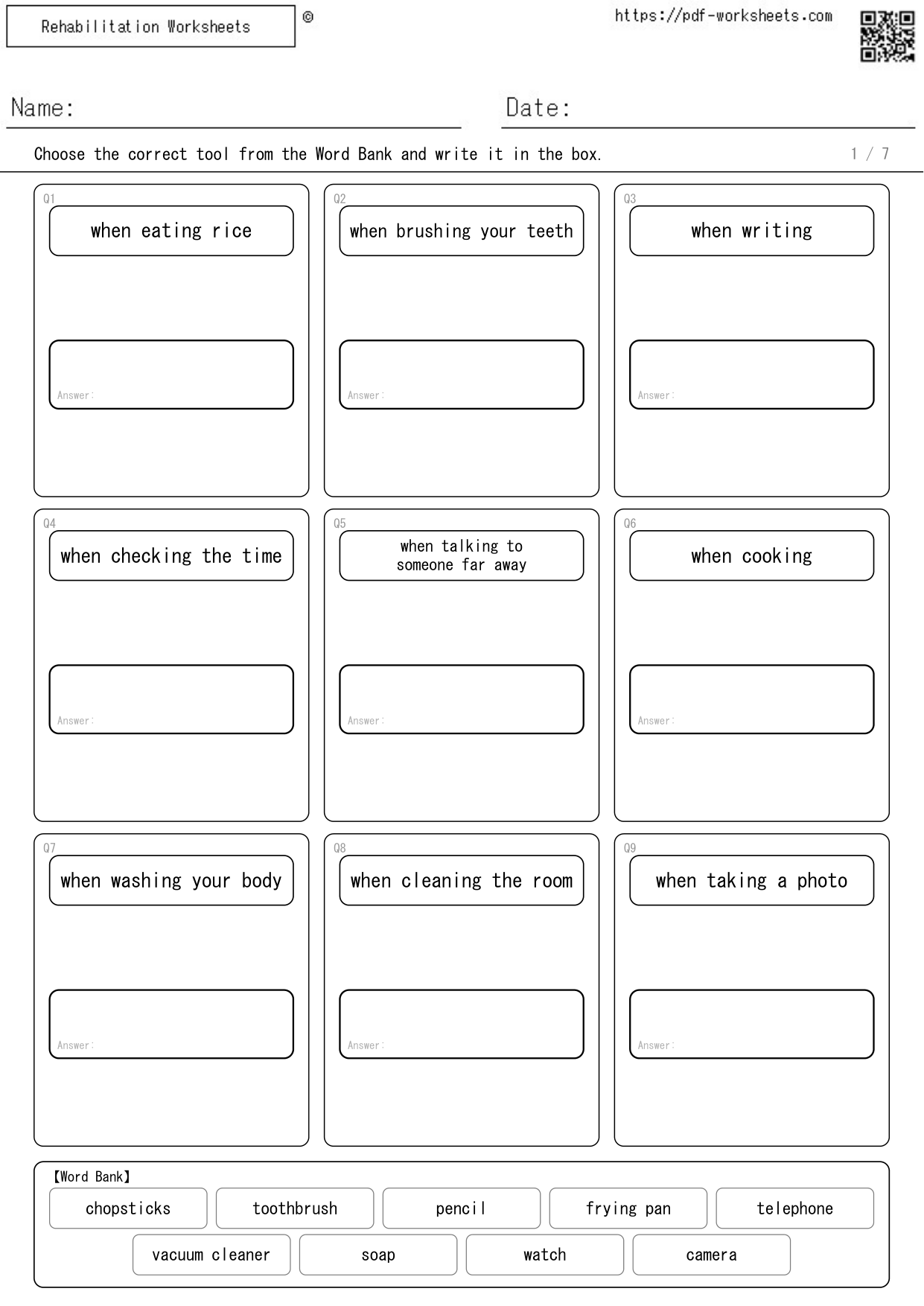
Choose the tool for each situation (9 choices)
Nine questions and nine choices per sheet. Some tools do similar jobs — a knife for cutting a cake and scissors for cutting paper — so the reader has to match each tool to the right situation.
Task to choose the right tool for each situation from the Word Bank and write it, 9 choices (7 sheets)
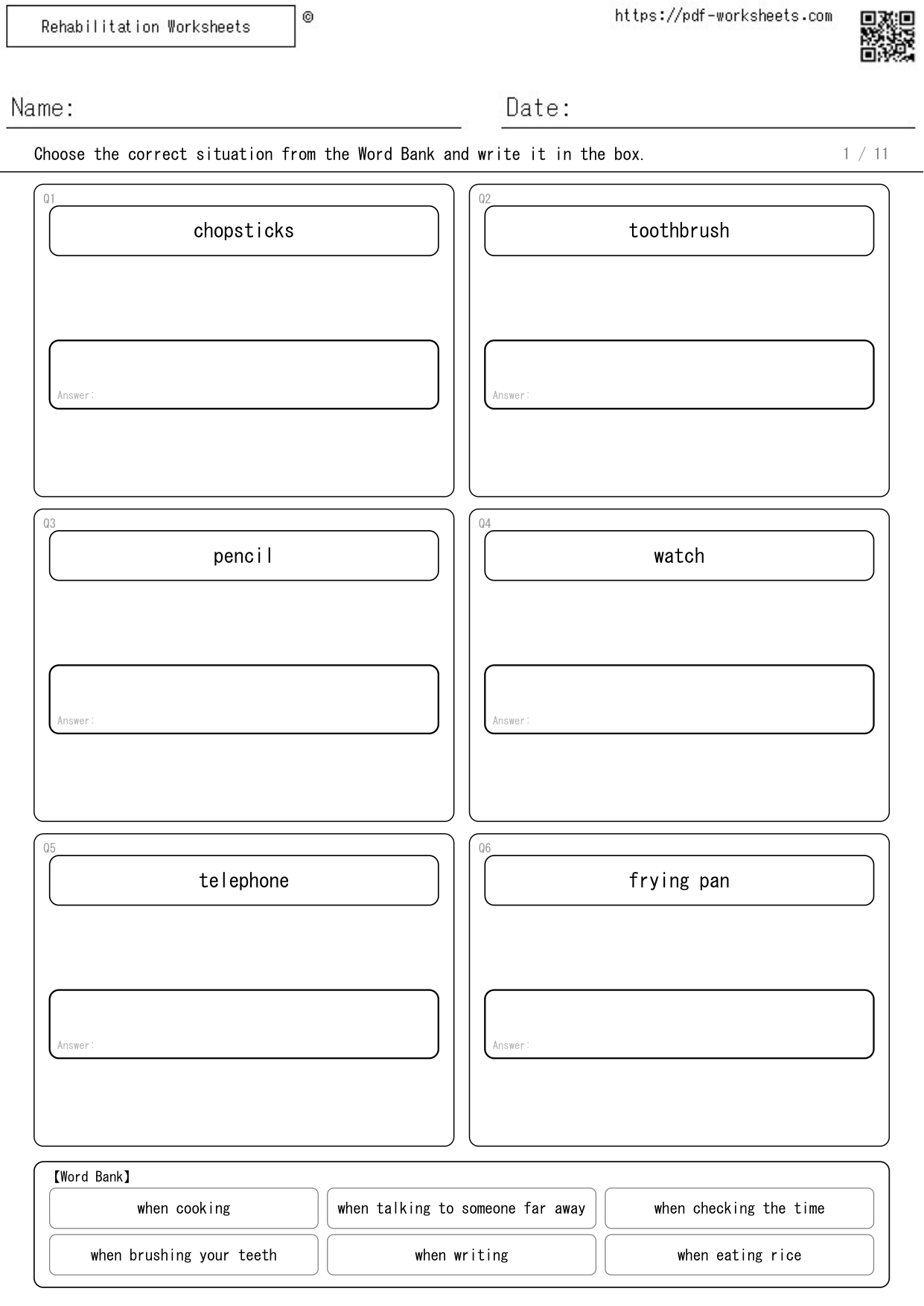
Choose when each tool is used (6 choices)
The direction is reversed: look at a tool such as “umbrella” and choose the situation it is used in, such as “when going out on a rainy day.” The answers are short phrases, so there is more to read and more to write.
Task to choose when each tool is used from the Word Bank and write it, 6 choices (11 sheets)
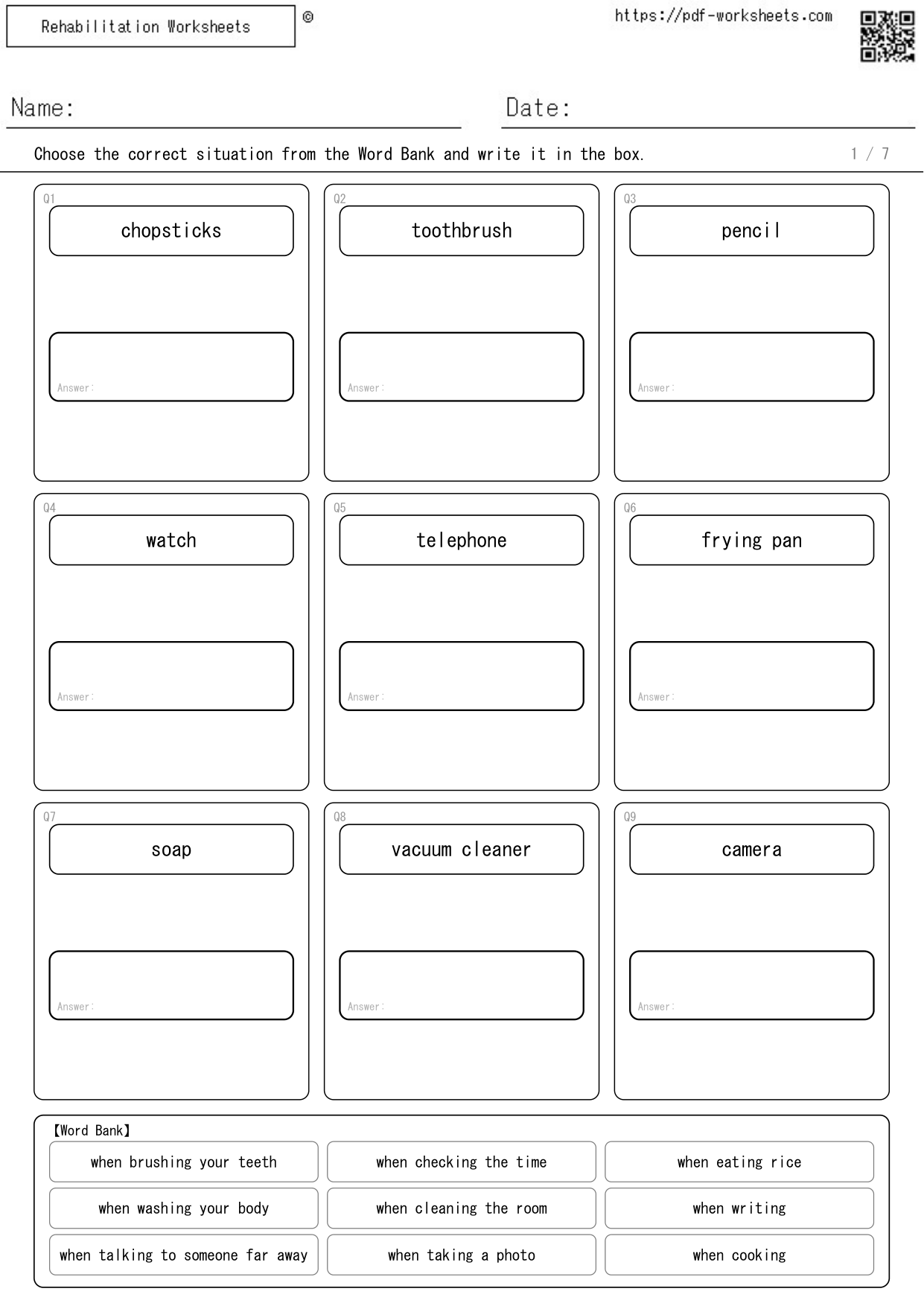
Choose when each tool is used (9 choices)
The hardest step in this series. Compare nine situation phrases and choose the one that fits each tool.
Task to choose when each tool is used from the Word Bank and write it, 9 choices (7 sheets)
Comments